



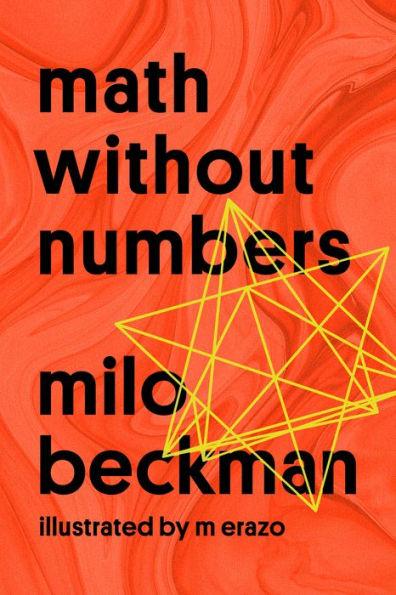
Math Without Numbers
Šifra proizvoda:
Cena na sajtu:
2,376.00RSD
Nema na zalihama
An illustrated tour of the structures and patterns we call „math“
The only numbers in this book are the page numbers.
Math Without Numbers is a vivid, conversational, and wholly original guide to the three main branches of abstract math–topology, analysis, and algebra–which turn out to be surprisingly easy to grasp. This book upends the conventional approach to math, inviting you to think creatively about shape and dimension, the infinite and infinitesimal, symmetries, proofs, and how these concepts all fit together. What awaits readers is a freewheeling tour of the inimitable joys and unsolved mysteries of this curiously powerful subject.
Like the classic math allegory Flatland, first published over a century ago, or Douglas Hofstadter’s Godel, Escher, Bach forty years ago, there has never been a math book quite like Math Without Numbers. So many popularizations of math have dwelt on numbers like pi or zero or infinity. This book goes well beyond to questions such as: How many shapes are there? Is anything bigger than infinity? And is math even true? Milo Beckman shows why math is mostly just pattern recognition and how it keeps on surprising us with unexpected, useful connections to the real world.
The ambitions of this book take a special kind of author. An inventive, original thinker pursuing his calling with jubilant passion. A prodigy. Milo Beckman completed the graduate-level course sequence in mathematics at age sixteen, when he was a sophomore at Harvard; while writing this book, he was studying the philosophical foundations of physics at Columbia under Brian Greene, among others.
Editorial Reviews
With charm, unwavering enthusiasm, and a lot of cartoons, Math Without Numbers waltzes the reader through a garden of higher mathematics.“
–Jordan Ellenberg, professor of mathematics, University of Wisconsin-Madison, author of How Not To Be Wrong
„So delightful! Mathematics is playful, surprising, and enchanting, but those qualities are often obscured behind intimidating equations and formalism. Milo Beckman brings them out into the open for everyone to share.“
–Sean Carroll, author of Something Deeply Hidden: Quantum Worlds and the Emergence of Spacetime
„Math Without Numbers explores deep mathematical topics–and shows how mathematicians think–in completely readable prose. The puzzles and games are bonuses. Very enjoyable.“
–Will Shortz, crossword editor, The New York Times
„The book’s accessible language and illustrations makes understanding some of the most complex (and possibly most intimidating) math concepts feel as effortless as breathing. Beckman’s approachable writing and Erazo’s delightful illustration combine to tell an insightful and entertaining story about math.“
–Giorgia Lupi and Stefanie Posavec, co-authors of Dear Data and Observe, Collect, Draw!
„This is the book for you if you’ve ever been curious about the wonderful ideas and concepts underlying modern math, but been too frightened to make a start. Milo Beckman gives us a friendly introduction to unfamiliar concepts and ideas that show why modern math is such a fascinating and rewarding branch of human thought.“
–Graham Farmelo, author of The Universe Speaks in Numbers
„Math Without Numbers offers an accessible and whimsically illustrated glimpse of what pure mathematicians study, all while capturing the playful spirit with which they do it.“
–Grant Sanderson, creator of 3blue1brown
„A cheerful, chatty, and charming trip through the world of mathematics and its relation to the world of people–and not a number in sight! Everyone should read this delightful book. Even mathematicians.“
–Ian Stewart, professor of mathematics, University of Warwick, author of Do Dice Play God?
„The book’s accessible language and illustrations makes understanding some of the most complex (and possibly most intimidating) math concepts feel as effortless as breathing.“
–Stefanie Posavec, co-author of Dear Data and Observe, Collect, Draw!
„The book does an excellent job of capturing the essence of what makes math interesting while avoiding intimidating technical details. A fine addition to my collection.“
–Shareef Jackson, STEM Diversity Advocate
„A playful paean to the pleasures of studying higher math . . . Readers with an abundance of curiosity and the time to puzzle over Beckman’s many examples, riddles, and questions, will make many fascinating discoveries.“
–Publishers Weekly
„A pleasant, amusing look at mathematics as a description of everything.“
–Kirkus Reviews
– From the Publisher
07/13/2020
Beckman, a math prodigy who captained the New York City Math team at age 13, debuts with a playful paean to the pleasures of studying higher math. Arguing „that everything–plants, love, music, everything–can (in theory) be understood in terms of math,“ he uses analogies, puzzles, and formal logic–but no equations–to tackle intriguing questions from various fields. For example, from topology, „geometry’s looser and trippier cousin,“ he asks when two shapes can be considered the same, producing the surprising answer that it’s when one can be transformed „into the other by stretching and squeezing, without any ripping or gluing.“ Another question revolves around infinities–namely, are some larger than others? Moving on to dimensions, he considers why structures with more than three, though nonexistent, are both theoretically possible and intellectually useful for mathematicians. Beckman’s conviction that math provides the tools to understand everything gets its best showing when he tackles abstract algebra, explaining, among a blizzard of examples, how modeling, where „math connects to the real world,“ can theoretically predict the outcomes of systems like economics. Readers with an abundance of curiosity and the time to puzzle over Beckman’s many examples, riddles, and questions, will make many fascinating discoveries. Agent: Jay Mandel, William Morris Endeavor. (Oct.)
– Publishers Weekly
2020-06-13
A math prodigy examines how mathematicians view the world.
Math enthusiasts have a spotty record explaining their favorite subject to a popular audience, even when they exert themselves to hold attention with calculating tricks, paradoxes, or illusions. Beckman, who entered Harvard at age 15, eschews them all, maintaining that everything–„plants, love, music, everything“–can be understood in terms of math and proceeds to explain how mathematicians try. They love to overthink things. „We take some concept everyone understands on a basic level, like symmetry or equality, and pick it apart, trying to find a deeper meaning in it.“ His first example is a simple concept: shape. By the mathematical definition, a square and a circle have the same shape, but a figure 8 is different. It turns out that thinking about shapes is a major field of study called topology. Beckman admits that this has no practical significance, but it’s odd and interesting, and most readers will agree. There seems little to say about infinity, but this turns out to be wrong and pleasantly bizarre. If you remove any number of marbles from a bag containing infinite marbles, what’s left is still infinite. Adding one or 1 trillion–still exactly infinite. Infinity times infinity…the same. Is any quantity more than infinity? Yes; it’s called the continuum, and Beckman offers a fairly clear explanation. Ultimately, the author argues that math is not about numbers or equations but models. A model breaks down phenomena into specific rules that, when applied, explain it. A few simple rules produce a quasi-game remarkably similar to Darwinian natural selection. Beckman concludes with a model of an empty space containing 17 particles that follow well-defined if absurd rules, but the end result is the „standard model,“ physicists’ best interpretation of how the universe operates.
A pleasant, amusing look at mathematics as a description of everything.
– Kirkus Reviews
| Autor | MILO BECKMAN |
|---|---|
| Godina izdanja | 2022 |
| Pismo | |
| Povez i format | Meki |
Za više informacija o proizvodu poslati upit na [email protected]
Od istog autora
Na žalost nemamo više izdanja ovog autora.


Recenzije
Još nema komentara.