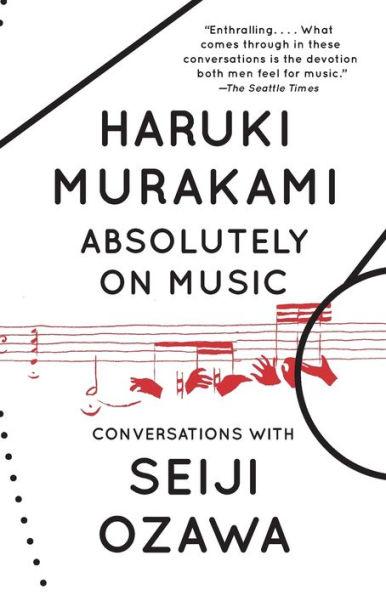
A deeply personal, intimate conversation about music and writing between the internationally acclaimed, best-selling author and the former conductor of the Boston Symphony Orchestra.
In Absolutely on Music, internationally Haruki Murakami sits down with his friend Seiji Ozawa, the revered former conductor of the Boston Symphony Orchestra, for a series of conversations on their shared passion: music. Over the course of two years, Murakami and Ozawa discuss everything from Brahms to Beethoven, from Leonard Bernstein to Glenn Gould, from Bartók to Mahler, and from pop-up orchestras to opera. They listen to and dissect recordings of some of their favorite performances, and Murakami questions Ozawa about his career conducting orchestras around the world.
Culminating in Murakami’s ten-day visit to the banks of Lake Geneva to observe Ozawa’s retreat for young musicians, the book is interspersed with ruminations on record collecting, jazz clubs, orchestra halls, film scores, and much more. A deep reflection on the essential nature of both music and writing, Absolutely on Music is an unprecedented glimpse into the minds of two maestros.
Editorial Reviews
A fascinating collection of conversations. . . . The unpretentious and engaging dialogues between passionate artists–the bewitching writer in whose novels music plays a prominent part and the indefatigable, amiable conductor–make the pages fly.“ –The New York Times
„Highly entertaining. . . . A book that opens a new side of [Murakami’s] authorial persona.“ –San Francisco Chronicle
„Absolutely on Music is an unprecedented treasure. . . . Talking about music is like dancing about architecture, it’s often said, but what joy to watch these two friends dance.“ –The Guardian
„Enthralling. . . . What comes through in these conversations is the devotion both men feel for music; the degree to which every detail of a work matters to them.“ –The Seattle Times
„Fascinating. . . . [Murakami’s] preparation and curiosity draw out Mr. Ozawa wonderfully.“ –The Wall Street Journal
„An enviable word picture of the artistic life of two men at the top of their professional games. . . . [Absolutely on Music] offers so much that bears re-reading and considering.“ –The Washington Times
„Irresistibly seductive.“ –Evening Standard
„Refreshingly honest and enthusiastic, a mental sampler from both the writer and the musician.“ –The Buffalo News
„The book shines as a deep exploration into how a conductor does his job and how performer personalities, logistical factors, and mundane bureaucracies can change an orchestra’s sound.“ –The New Republic
„Intriguing insights about the nature of music. . . . In some ways, these conversations are High Fidelity for classical music fans.“ –Publishers Weekly
„A strange and delightful book. . . . [Murakami] describes music with rich and suggestive metaphors and images that capture something essential about the spirit of the music.“ –The Christian Science Monitor
– From the Publisher
07/25/2016
These chats between novelist Murakami and Ozawa, former conductor of the Boston Symphony Orchestra, contain intriguing insights about the nature of music. Over a two-year period (2010-2011), Murakami and Ozawa sat down to listen to and reflect upon matters as diverse as various recordings of Beethoven’s Third Piano Concerto, Brahms’s First Symphony, the music of Gustav Mahler, and the joys of conducting with Leonard Bernstein, whom Ozawa worked under in the 1960s. Ozawa reflects on the role of the conductor: „One of the distinguishing features of the conductor’s profession: the work itself changes you; the one thing a conductor has to do is to get sounds out of the orchestra; I read the score and create a piece of music in my mind, after which I work with the orchestra members to turn that into actual sounds, and that process gives rise to all kinds of things.“ In response to Murakami’s question about the emotions a Japanese conductor feels when conducting the music of Gustav Mahler, an Austrian Jew, Ozawa reflects that when an Easterner performs music written by a Westerner, it can have its own special meaning. Ozawa admits that he doesn’t approach conducting with preconceived ideas about how a score should sound or be played: „I don’t have anything to say until I’ve got a musician right in front of me.“ The tone of the book is deliberate and contemplative. In some ways, these conversations are High Fidelity for classical music fans. (Nov.)
– Publishers Weekly
08/01/2016
Beginning in November 2010, Japanese novelist Murakami (Colorless Tsukuru Tazaki and His Years of Pilgrimage) held a series of informal conversations with renowned conductor Ozawa. The transcriptions of these talks, with commentary by Murakami, reveal a probing and perceptive interviewer who teases out of Ozawa fascinating anecdotes about his career and the classical music scene in general. Ozawa was an assistant conductor under both Herbert von Karajan and Leonard Bernstein before assuming the directorship of the Boston Symphony Orchestra, and his perspectives on conductors and performers, and the differences among orchestras in Japan, America, and Europe are enlightening. The book unfolds at a leisurely pace; quite a bit of material is devoted to dissections of various vintage recordings, in which the two friends discuss details of interpretation and performance practice. The best of these musings deals with Gustav Mahler’s Symphony No. 1, in which Ozawa analyzes the work in the context of Mahler’s life and the societal decline of fin-de-sičcle Vienna. Little-known aspects of Ozawa’s musical persona are also revealed, such as his passion for Chicago blues and his love of teaching string quartet literature to young musicians. VERDICT Recommended for lovers of classical music and fans of Murakami. [See Prepub Alert, 5/23/16.]–Larry Lipkis, Moravian Coll., Bethlehem, PA
– Library Journal
2016-08-25
The edited texts of six engaging conversations about music between the celebrated Japanese writer and the noted conductor who led the Boston Symphony Orchestra for nearly 30 years.Although Murakami (The Strange Library, 2014, etc.) identifies himself as an „amateur,“ we learn throughout these discussions that he has been a longtime collector of classical recordings, a longtime listener, and a habitual member of audiences at classical concerts and operas. His knowledge of music is beyond impressive, as anyone who has read his novels already knows. He loves jazz, and one of the most interesting passages involves exchanges about blues in Chicago in the 1960s. Ozawa also declares a deep admiration for Louis Armstrong. Each conversation focuses on a certain aspect of Ozawa’s career, and the flow is generally chronological. We learn about his early experiences with Leonard Bernstein, and throughout, the conductor praises his early mentor, Hideo Saito; a later exchange deals comprehensively with the group Ozawa helped establish in his honor, the Saito Kinen Orchestra. Ozawa is quick to praise–individual musicians, older conductors, composers, orchestras (Cleveland gets a couple of nice nods)–and hardly says a discouraging word about anyone or anything, save his early experience conducting Tosca in Milan when he was startled to hear booing. (It disappeared as his engagement went along, however.) Although Murakami occasionally notes similarities and/or differences between the lives of a conductor and a writer–he mentions that both he and Ozawa begin working before dawn–the focus is almost entirely on music and on Ozawa’s career. We learn a lot about his work habits–for example, his fierce study of scores in preparation for performances–and his techniques for handling the immense demands on his time. He also states a deep conviction that the conductor’s task is to „convert the music exactly as it’s written into actual sound.“ A work that general readers will enjoy and the musical cognoscenti will devour.
– Kirkus Reviews










Recenzije
Još nema komentara.